The University of British Columbia
UBC - A Place of Mind
The University of British Columbia Vancouver campus
Math & Science Teaching & Learning through Technology
  • Home
  • Our story
    • Our Team
    • Contact Us
  • Research
  • Tech 4 STEM
  • STEAM
  • Elementary
    • Mathematics
      • Numbers
      • Patterns and Relations
      • Shape and Space
      • Data and Chance
    • Processes of Science
      • Classifying Objects
      • Observations
      • Measurement
      • Experiments
      • Interpreting Data
      • Developing Models
      • Scientific Method
    • Life Science
      • Characteristics of Living Things
      • Needs of Living Things
      • Animal Growth and Changes
      • Plant Growth and Changes
      • Habitats and Communities
      • Human Body
      • Diversity of Life
      • Ecosystems
    • Physical Science
      • Properties of Objects and Materials
      • Force and Motion
      • Properties of Matter
      • Materials and Structures
      • Light and Sound
      • Forces and Simple Machines
      • Electricity
      • Chemistry
    • Earth and Space Science
      • Surroundings
      • Daily and Seasonal Changes
      • Air, Water, and Soil
      • Stars and Planets
      • Weather
      • Renewable and Non-Renewable Resources
      • Exploration of Extreme Environments
      • Earth’s Crust
  • Secondary
    • Mathematics
      • Numbers
      • Relations and Functions
      • Trigonometry and Geometry
      • Sequences and Series
      • Statistics and Probability
      • Financial Mathematics
      • Calculus
        • Differential Calculus
        • Integral Calculus
    • Physics
      • Vectors
      • Kinematics
        • 1-D Kinematics
        • 2-D Kinematics
      • Dynamics
        • Forces and Newton’s Laws
        • Springs
        • Newton’s Laws
      • Momentum
        • Collisions
        • Momentum Principle
      • Work, Energy, Power
      • Thermodynamics
      • Circular Motion
      • Gravitation
      • Wave motion and Optics
      • Particle and Nuclear Physics
      • Equilibrium
      • Electrostatics
      • Circuits
      • Electromagnetism
      • Special Relativity
    • Chemistry
      • Skills and Processes
        • Safety
        • Measurement
        • Data Representation
      • Matter
  • Contribute
  • Spotlight
» Home » neutron

neutron

Model of the Atom

Model of the Atom

By almacd13 on June 17, 2014

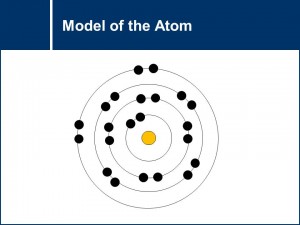
The model of the atom is explored by looking at role and placement of electrons, protons and neutrons in an atom. Questions get students to practice drawing Rutherford-Bohr models of the atom. The role that the gain and loss of electrons have in chemical reactions is also explored which leads to an conclusion about the stability of a full valence electron shell.


Download PDF     Download PPT

Read More | No Comments

Department of Curriculum and Pedagogy
Vancouver Campus
Scarfe Building
2125 Main Mall
Vancouver, BC Canada V6T1Z4
Tel 604 822 5422
Fax 604 822 4714
Email marina.milner-bolotin@ubc.ca
Back to top
The University of British Columbia
  • Emergency Procedures |
  • Terms of Use |
  • Copyright |
  • Accessibility