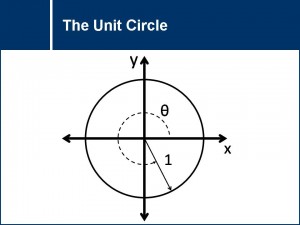
The Unit Circle
The exact value of the trigonometric ratios for 0°, 30°, 45°, 60°, and 90° will be discovered by analyzing the unit circle using special triangles.

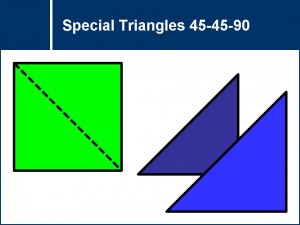
45-45-90 Triangles
The ratios of the 45-45-90 triangle will be derived using the Pythagorean Theorem. The properties of the special triangles can then be applied to the trigonometric ratios of sine and cosine.
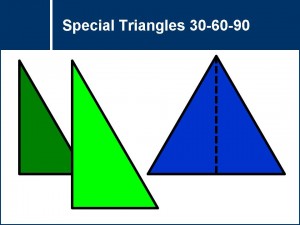
30-60-90 Triangles
The ratios of the 30-60-90 triangle will be derived using the Pythagorean Theorem. The ratios when the be applied to quickly find the side lengths of any 30-60-90 triangle.
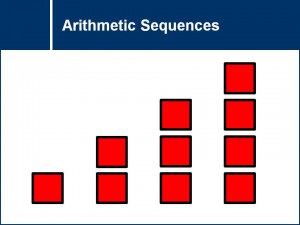
Arithmetic Sequences
This question set introduces the concept of arithmetic sequences and their properties. Students will be tested on their ability to recognize patterns and think critically to derive general formulas.
Arithmetic Series
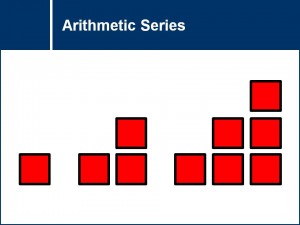
How can the sum of all the numbers between 1 and 100 be found quickly? This question set covers ways to solve this problem as well as finding the sum of more complex arithmetic series.
Geometric Sequences
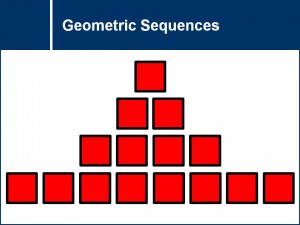
Consider a sequence of numbers where the next number is always twice as larger as the previous. This question set reveals how the nth term of a geometric sequence can be found, where consecutive terms in the sequence are always in the same ratio.
Geometric Series
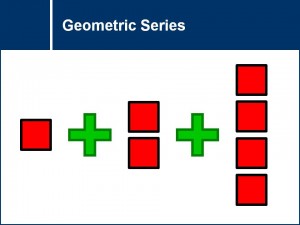
A general formula to find the sum of the first n terms of a geometric series is discovered. The properties of this formula will then be tested in the following questions.
Parallel Circuits
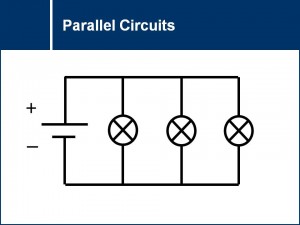
The behavior of voltage, current and resistance will be analyzed in parallel circuits. The power dissipated in parallel circuits will also be compared with the power dissipated in series circuits.
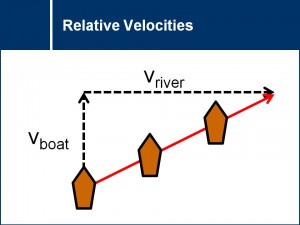
2-D Relative Velocity
An object can appear to have different velocities depending on the velocity of an observer. In this problem set, 2-D scenarios will be analyzed from different frames of reference in order to determine the velocity of one object relative to another.
Research Presentation of MSTLTT at the Science and Math Education Seminar
On Thursday, February 28th, 2012, the MSTLTT Team (graduate students Heather Fisher and Alexandra McDonald and I) presented our research on the development and implementation of conceptual questions at the S&METRI monthly meeting. S&METRI represents a group of mathematics and science educators at the Department of Curriculum and Pedagogy at UBC who come together to […]
MSTLTT Project Funded for Another Year!
We are very happy that our project – Mathematics and Science Teaching and Learning Through Technology had been funded for another year by UBC Teaching and Learning Enhancement Fund. We are very happy that our project – Mathematics and Science Teaching and Learning Through Technology had been funded for another year by UBC Teaching and […]

Counting Techniques
This question set introduces the Fundamental Counting Principle to solve multi-step counting problems. No previous knowledge in counting is required.

Permutations
This question set teaches how many ways a selection can be made if the order matters. The properties of this formula will then be analyzed in the following questions.
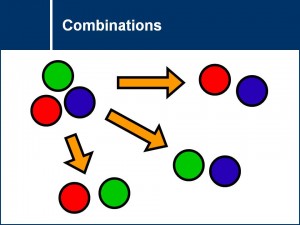
Combinations
This problem set goes how to solve counting problems were the order of the selection does not matter. The formula for permutations will be used to derive the formula used to determine the number of combinations.
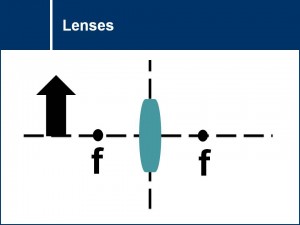
Lenses
This set of conceptual questions are designed for students after they have just learnt about lenses. It is designed to make sure they understand how ray diagrams work and the properties of lenses.